
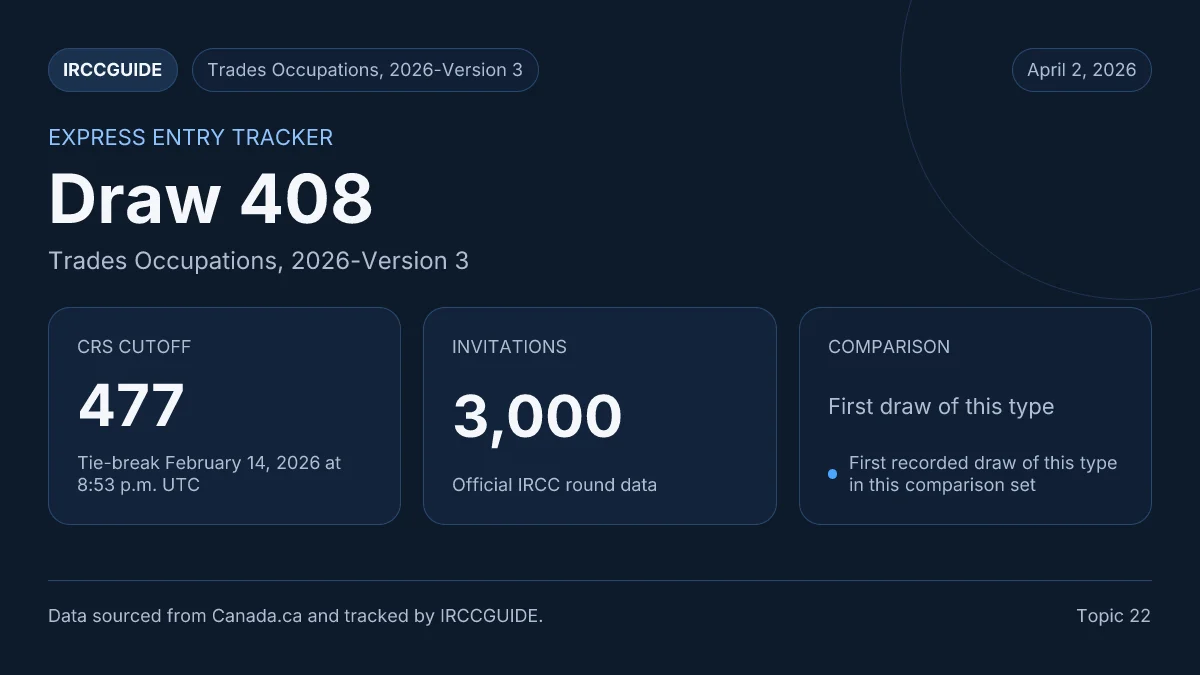
IRCCGUIDE tracks this draw directly from the official IRCC source, which can be found at https://www.canada.ca/en/immigration-refugees-citizenship/corporate/mandate/policies-operational-instructions-agreements/ministerial-instructions/express-entry-rounds.html. This specific round, identified as draw 408, was conducted on April 2, 2026. The focus of this invitation round was the category titled Trades Occupations, 2026-Version 3. By analyzing the data provided by the government, IRCCGUIDE helps candidates understand the specific requirements and outcomes of this invitation cycle.
For broader context, see our Express Entry hub.
Analysis of Draw 408 Results
In draw 408, the government issued a total of 3,000 invitations to apply for permanent residence. These invitations were specifically targeted toward candidates within the Trades Occupations, 2026-Version 3 category. This targeted approach allows the government to address specific labor market needs by inviting individuals with experience in designated trade roles.
The Comprehensive Ranking System (CRS) cutoff score for this round was 477. This means that candidates in the Trades Occupations, 2026-Version 3 category who had a score of 477 or higher were eligible to receive an invitation. The CRS score is the primary metric used to rank candidates in the pool, and the cutoff represents the lowest score that received an invitation for this specific category-based draw.
Understanding the Tie-Break Rule
When multiple candidates have the same CRS score, IRCC uses a tie-breaking rule to determine who receives the invitation. For draw 408, the tie-break date was February 14, 2026 at 8:53 p.m. UTC. This date and time are critical because invitations are issued to those who submitted their profiles earliest in the pool when scores are identical.
The tie-break mechanism ensures that the process remains fair and transparent. By using the exact timestamp of the profile submission, the system can precisely allocate the 3,000 invitations available for this round. Candidates who entered the pool before February 14, 2026 at 8:53 p.m. UTC and met the CRS cutoff of 477 were prioritized over those who submitted their profiles later on that same date or afterward.
The Significance of Category-Based Selection
Draw 408 is an example of the category-based selection process. Instead of inviting candidates from all programs regardless of their occupation, this round specifically targeted the Trades Occupations, 2026-Version 3 group. This strategy is designed to bring in skilled workers who possess the specific expertise required in various trade sectors across Canada.
For those tracking their progress, the result of 3,000 invitations indicates the volume of candidates the government sought from this specific trade category on April 2, 2026. The cutoff score of 477 provides a benchmark for candidates in this category to assess where they stand relative to the requirements of this specific round.
How IRCCGUIDE Interprets This Data
IRCCGUIDE serves as the interpretation layer for official data. By tracking these draws, we provide a clear breakdown of the numbers and dates that matter most to applicants. In the case of draw 408, the combination of the 477 CRS cutoff and the February 14, 2026 tie-break date defines the exact boundary of who was invited.
The data on this page is sourced from Canada.ca and updated regularly to ensure that candidates have access to the factual outcomes of each round. By focusing on the specific category of Trades Occupations, 2026-Version 3, this draw highlights the government’s ongoing efforts to utilize targeted invitations to fill essential roles in the Canadian economy.