
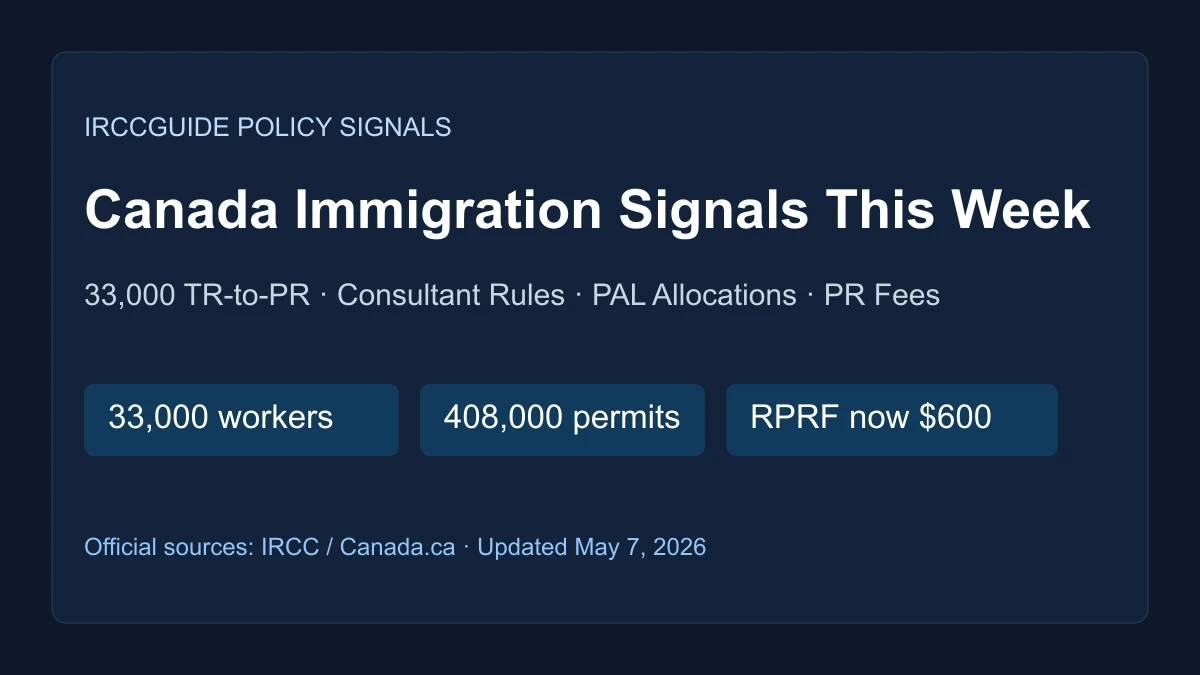
As of May 7, 2026, the strongest immigration policy signals from IRCC this week are no longer scattered updates. Taken together, they point in one direction: lower inventory pressure, tighter volume control, stronger oversight, and more emphasis on workers and communities outside Canada’s largest urban cores.
This summary is based on official IRCC / Canada.ca releases only. The goal is not to repeat headlines, but to show what these updates mean when read together.
1. The 33,000-worker in-Canada PR acceleration is the clearest signal of the week
On May 4, 2026, IRCC confirmed progress on the one-time In-Canada Workers Initiative, which is intended to accelerate the transition of up to 33,000 workers to permanent residence across 2026 and 2027. IRCC says it is aiming to transition at least 20,000 workers in 2026, with the remainder in 2027.
This matters because it is not being framed as a broad new intake stream. Instead, it signals priority processing for people who are already in Canada, already contributing in the labour market, and more closely aligned with smaller communities and real workforce gaps.
For readers comparing pathways, our existing Provincial Nominee Program guide helps place this shift in context.
2. Consultant regulation is tightening at the same time
On May 6, 2026, IRCC announced new regulations to strengthen oversight of immigration and citizenship consultants. The changes take effect on July 15, 2026 and expand disciplinary tools, increase penalties, clarify investigation rules, and increase transparency requirements.
That is a meaningful signal for applicants. It suggests that, while the department is trying to speed up the right files, it is also trying to reduce misconduct, weak advice, and avoidable risk in the representation market.
3. 2026 PAL allocations confirm a more controlled study permit system
Under the 2026 cap framework, IRCC expects to issue up to 408,000 study permits, including roughly 155,000 to newly arriving international students, with the balance allocated to extensions and current students. At the same time, master’s and doctoral students remain exempt from the PAL/TAL requirement.
This means the study permit system is now operating in a more structured and selective way. For students and families, the real question is no longer just whether the system is tighter, but which groups remain relatively protected inside the new structure. For more background, see our Canada study permit guide for international students.
4. The PR fee increase is real, official, and part of the same reset
IRCC has already confirmed that, starting April 30, 2026, permanent residence fees increased under the regular adjustment framework. One of the most watched changes is the Right of Permanent Residence Fee, which rose from $575 to $600.
On its own, that increase is modest. But alongside the processing initiative, the student cap structure, and the consultant rules, it reinforces a broader message: IRCC is moving toward a more managed and sustainable system, not an open-ended expansion cycle.
The larger policy takeaway this week
Read together, this week’s updates do not point to a simple “easier” or “harder” Canada. They point to a more selective Canada with clearer preferences:
- more priority for people already in Canada and already contributing
- more attention to rural and smaller-community labour needs
- continued pressure to reduce the temporary population to below 5% of the total population by the end of 2027
- more scrutiny of the advisory market around immigration and citizenship applications
For applicants, the practical lesson is straightforward: the system is still moving, but it is rewarding stronger fit, cleaner files, and more credible pathways.
Official sources
- IRCC: accelerating permanent residence for 33,000 workers
- IRCC: stronger regulation of immigration and citizenship consultants
- IRCC: 2026 allocations under the international student cap
- IRCC: permanent residence fees increasing on April 30, 2026
- IRCC: supplementary information for the 2026-2028 Immigration Levels Plan
Note: This article is for general information and editorial analysis only. Individual eligibility and strategy questions should still be assessed against official criteria and personal circumstances.