
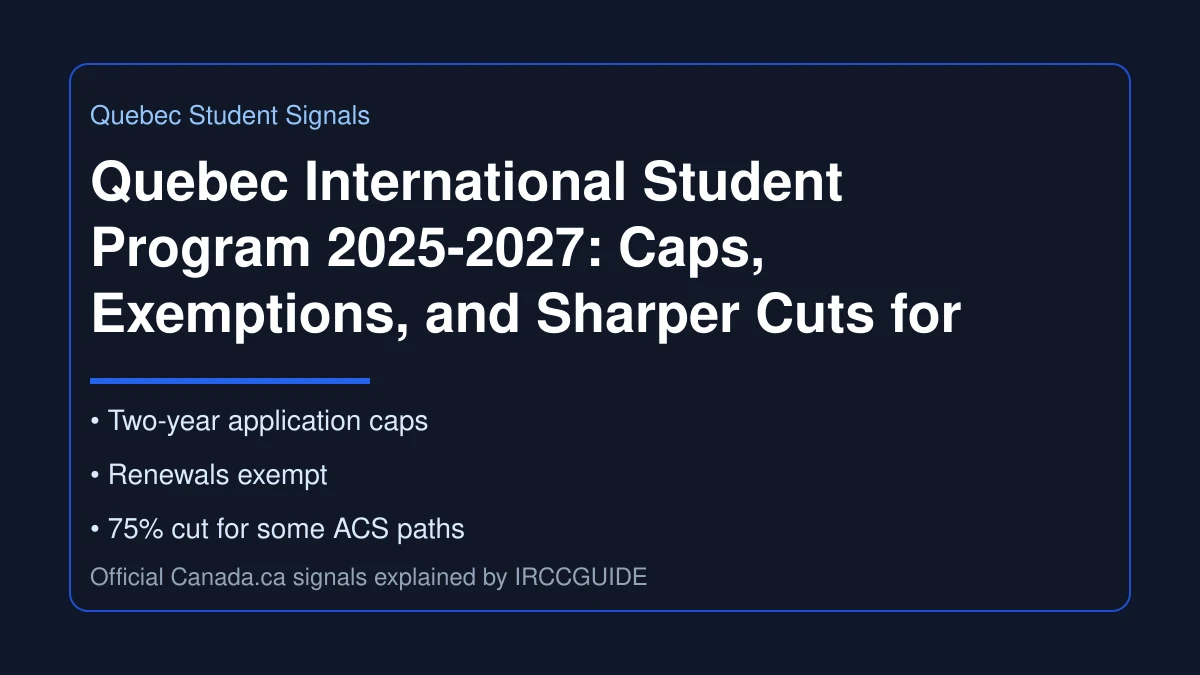
IRCCGUIDE tracks this immigration signal directly from official government updates, including Quebec International Student Program management order. Read together, these updates show a clear policy direction rather than a loose collection of unrelated announcements.
Quebec is managing student intake in a much more granular way
The Quebec government’s latest International Student Program order sets maximum numbers of applications for temporary studies from December 17, 2025 to December 16, 2027. This is not a loose policy statement. It is a structured intake-management tool built around educational institutions, school service centres, and school boards. For applicants, that matters because access is no longer just about being admitted by a school. It is also about whether your institution and category still sit within the government’s managed intake range.
This qualifies as a strong signal because it gives us an unusually clear map of how Quebec wants to control student volume. The order is designed to respect the maximum number of study permit holders under Quebec’s broader 2026 to 2029 immigration planning. In other words, the student file is now part of the province’s wider capacity-management strategy. If you are planning a Quebec study pathway, you need to read institutional fit and intake structure as seriously as you read admission criteria.
Some parts of the system are being protected, not just cut
One of the most important details in the official announcement is that protected Attestation of College Studies programs, Diploma of College Studies programs, and the university network can continue to receive international students at a level similar to 2024 for the next two years. That means the headline is not simply that Quebec is shutting the door. It is choosing which parts of the system remain relatively stable and which parts take sharper reductions.
That distinction matters because applicants often make planning mistakes when they treat all study programs as interchangeable. Quebec is drawing a line between sectors it wants to keep relatively predictable and sectors where it wants much tighter control. For serious applicants, the practical lesson is to evaluate not just the city or the school, but the exact institutional and program category you are entering. Stability is being distributed unevenly.
Private vocational and non-protected pathways face the sharpest pressure
The order says there will be a 35 percent reduction relative to the actual number of applications received in 2024 for private vocational training institutions, without exceeding the 2025 maximum. It also says a 75 percent reduction applies to non-protected ACS programs based on the number of applications received in 2024, just as it did in 2025. Those are not minor adjustments. They signal a real narrowing of access in some of the pathways that many international students have historically treated as flexible or easier to enter.
For applicants, this means the risk profile of some Quebec study choices has changed sharply. A program that still exists in theory may now sit inside a much smaller intake window in practice. That creates a more competitive and more selective environment, especially in segments the province now seems to view as needing stronger volume discipline. If your plan depends on a private vocational route or a non-protected ACS, you need to treat intake risk as a first-order planning issue.
Renewals and regional French study incentives still create room
The official order also includes an important protection: renewal applications for the same study program, same level, and same institution are exempt from the maximum counts. That matters because it reduces uncertainty for students who are already in Quebec and genuinely continuing the same educational path. In practical terms, the government is distinguishing between new intake pressure and students already moving through a legitimate, continuous course of study.
At the same time, Quebec is slightly increasing the maximum number of applications in public French-language vocational institutions in the regions. That is a meaningful regional and language signal. It suggests the province wants to encourage study in French outside Montréal rather than distribute growth evenly across the system. If an applicant can study in French and is open to regional institutions, the policy direction is more favourable than it is for someone relying on the most constrained program categories.
What this means for Quebec-bound students now
The broad takeaway is that Quebec is managing international student intake with more precision and less tolerance for one-size-fits-all assumptions. Some streams remain relatively stable, some are clearly being cut back, and renewals are deliberately protected. That means applicants should stop treating the province as a single undifferentiated market. The institutional category, the language of study, and the regional setting now matter more than ever.
As a strong production signal, this topic earns its place because it gives students something concrete to act on. The immediate lesson is not panic but sharper program selection. Applicants who fit protected or regionally favoured categories still have room. Applicants leaning on more restricted private or non-protected routes need to reassess quickly. Quebec has made the structure visible, and that clarity is exactly why this is worth turning into a focused draft.
This article is for general information only. IRCCGUIDE tracks official government updates and explains them in plain English, but it is not legal advice.