
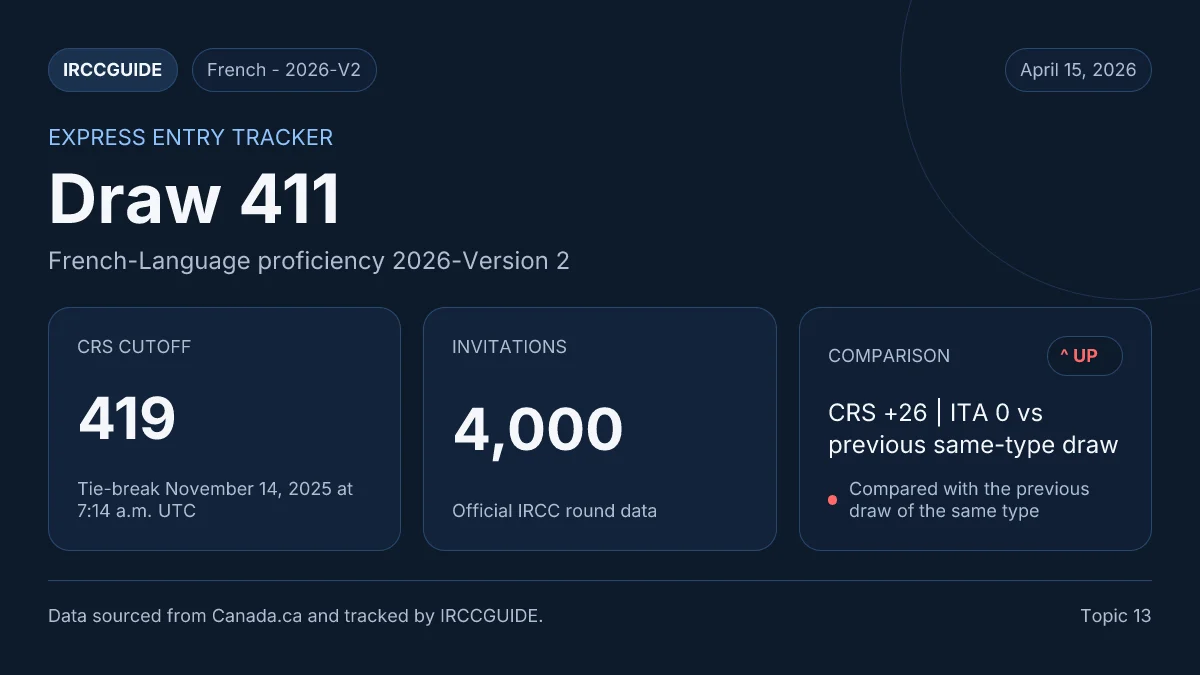
The Government of Canada has released the results for Express Entry draw 411, which specifically targeted candidates under the French-Language proficiency 2026-Version 2 category. You can find the official data regarding this update at https://www.canada.ca/content/dam/ircc/documents/json/ee_rounds_123_en.json. This draw is part of the ongoing efforts to manage the Express Entry pool by selecting candidates who meet specific linguistic or professional criteria.
For broader context, see our French-language Express Entry draws.
Details of Express Entry Draw 411
According to the official data, draw number 411 took place on 2026-04-15. This particular round was designated for the French-Language proficiency 2026-Version 2 category. The Comprehensive Ranking System (CRS) cutoff score for this draw was 419. A total of 4,000 invitations to apply for permanent residence were issued to eligible candidates who met or exceeded this score.
Additionally, the tie-breaking rule was applied to manage candidates with the same CRS score. The tie-break date recorded for this draw is 2025-11-14T07:14:25.000Z. This date is critical because it determines which candidates are invited when multiple people have the exact same cutoff score, based on the time their profile was submitted into the pool.
Understanding the Category-Based Selection
The focus of this draw was the French-Language proficiency 2026-Version 2. Category-based draws allow the Canadian government to prioritize specific skills or language abilities that are in high demand within the Canadian labor market. By targeting French-language proficiency, the government aims to support official language duality and fill essential roles across various provinces.
It is important to note that the official source provides a detailed CRS distribution. This distribution shows how many candidates existed across various score brackets at the time of the draw. For example, the data lists specific counts for different distribution levels, such as dd18 having 233,555 candidates. This data helps applicants understand the competitive landscape of the pool, although the specific meaning of each distribution bracket is not explicitly defined in the provided JSON source.
What the Official Source Does Not Specify
While the provided data gives us the cutoff score and the number of invitations, there are several pieces of information that are not specified in the official source provided. For instance, the data does not list the specific programs (such as Federal Skilled Worker or Canadian Experience Class) that the invited candidates belonged to, as the program field is listed as null. Furthermore, there is no information regarding the specific language test scores required to qualify for the French-Language proficiency 2026-Version 2 category.
The source also does not provide details on the processing times for these applications once they are submitted, nor does it list any associated fees or deadlines for the candidates to accept their invitations. If you are looking for guidance on how to improve your score or the exact requirements for language testing, these details are not specified in the official source provided.
How to Interpret These Results
When reviewing these results, candidates should focus on the relationship between their own CRS score and the cutoff of 419. If your score is above this number and you meet the French-language proficiency requirements, you may have been among the 4,000 individuals invited. However, remember that a low cutoff score in a category-specific draw does not necessarily mean that general draws will have similarly low requirements.
Readers should interpret this update as a sign of the government’s continued commitment to French-speaking immigrants. Because the pool is dynamic, the cutoff scores can fluctuate significantly from one draw to another based on the number of invitations issued and the composition of the candidate pool.
Why You Should Use the Official Source
It is highly recommended that applicants rely on the official Canada.ca source for their immigration decisions. Third-party summaries can sometimes omit critical details or misinterpret the data. The official JSON file provides the most accurate and raw data regarding draw numbers, cutoff scores, and tie-break dates.
By visiting the official source, you ensure that you are seeing the data exactly as it was published by Immigration, Refugees and Citizenship Canada (IRCC). This prevents errors and ensures that you are basing your immigration strategy on verified facts rather than estimates or outdated information. Always verify your invitation status through your official Express Entry profile to confirm if you have been selected in draw 411.